
Nostra Sheikha Leda
An Italian, muslim, anarchist, friend of the then socialist Mussolini

There was a time when Mussolini, the fascist dictator Benito Mussolini, sat in a living room in Milan surrounded by cushions, floor couches, and inscriptions of Quran verses. He sipped there Arab coffee amid the smell of sandal and incense in the company of an Italian anarchist, muslim woman: Leda.
It was 1913 and Mussolini was only a provincial man just arrived in Milan to direct the socialist magazine “Avanti”. He was an outsider called to bypass internal political disputes, and amid many career vultures, the not-yet Duce was fascinated by the sincere and fearless soul of Leda.
They exchanged few polite letters, and their friendship began.
Leda Rafanelli was already a prolific writer, a revolutionary anarchist, and a sharp observer of society. She converted to Islam during a stay in Alexandria, Egypt, finding in the Islamic thought the unity between heart and mind that is missing in the western approach to religion.
Once back in Milan, she continued a close, contemplative “Maomettanian” life, while studying Arabic. She was also in touch with the famous Italian Arabist Carlo Alfonso Nallino, which complimented her for her progresses, without ever realising though who she really was.
Mussolini was fascinated. He wrote to her: “You gifted me the illusion of the wonderful and mysterious Orient”; “We will read Nietzsche and the Quran.” He was a typical modern man, anxious, always unhappy about family and work, yet clearly fascinated by a human strength that will never be bold enough to embrace.
Leda politely avoided any advances. She was an observer, curious intellectual and she simply liked to converse about political ideas. Mussolini’s knowledge instead, was limited to the utility of the immediate. Leda lamented: “He knows nothing about religion or theosophic ideas (…) He knew Gandhi only because the Indian Apostle was in the newspapers, not to delve into him.
Thus the socialist guest would usually leave at the sunsets, time for the Magreb prayer, and Leda’s night work at the typography. Along with her comrades she was in fact already writing and printing, “La Libertà”, an anarchist magazine of that time.
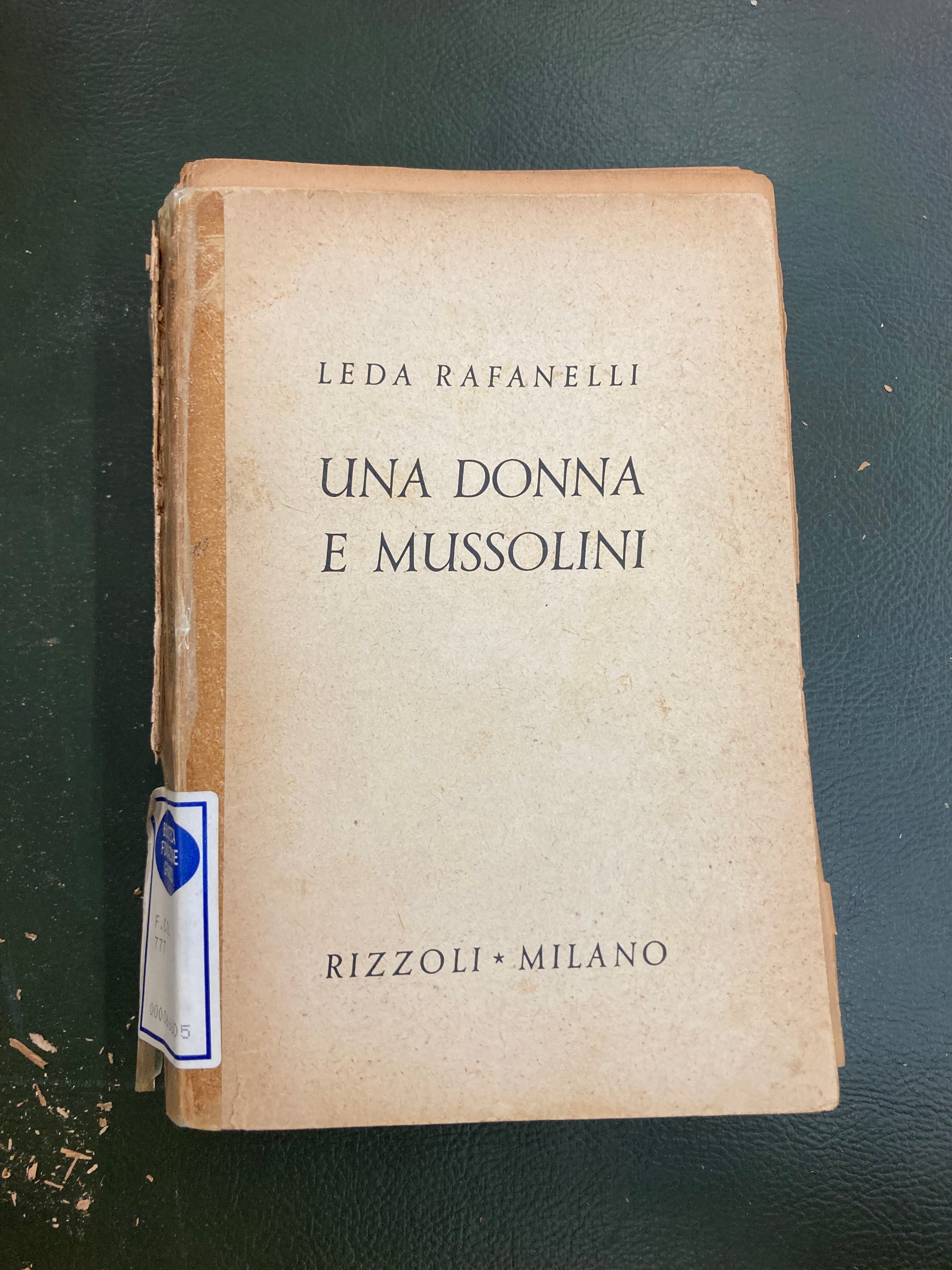
I discovered the account of these meetings at the Gramsci Foundation in Rome, where I found a copy of Leda’s book “A Woman and Mussolini”. Here, I also read some of her precious pamphlets with titles such: “Against school”, “From God to Freedom”, “Workers!”.
All Leda’s writings are permeated by profound passion for humanity and a unique equilibrium of social justice and understanding of human soul. She believed in God’s essence and put her faith in a religion that doesn’t demand to overlook the injustices of man-made laws.
She was a woman of the people, and she put her eloquence at the service of the people.
Her feminist thought today sounds even more revolutionary because it will be labeled as reactionary. She spoke to the heart of womanhood, and looked at emancipation as a tool to serve humanity, not egotistic needs. Her essay “To the Italian Mothers” is a brilliant, libertarian, acknowledge of that, and focuses on the fundamental role of motherhood in a society.
In her articles Leda urges mothers to protect their sons from the prejudice of society, and to nurture in them noble altruism and passion for freedom: “Teach them the love for the good and the hate for evil, and you will know that your mission will be fulfilled, that you can exclaim with joy, I have done my duty”, she incites.
She was undoubtedly a dreamer, but she had also a clear sense of life as a reality. “Not every woman will be a mother (…) Some will have many children, others just one, others no one”. However, every woman should dedicate herself to feminine mansions, she acknoledge, tasks whose aim is to be useful to society.
Overall, her writings are moved by the noble cause to move humanity toward an enlighten freedom. In her, Bakunin and Islamism find no contradiction: she thought religion as an inwardly tool to raise the soul, and she firming believe in a life dedicated to the interests of the community.
Mussolini would listen to her for hours, inebriated by the smell of bukhur, the incense burning. He usually go along with any of her ideas, although Leda spotted him publicly professing the opposite several time. He was intellectually a quite average man, and he used to comply with anything convenient to him. In that living room, taking Leda seriously was Mussolini’s main interest.
Then, the thunderbolt of the war arrived.
Mussolini openly claimed a neutral position while behind the scenes advocating for intervention. When exposed, he was kicked out by the Socialist Party. The rest is history: he will unstoppable continue his run to power, till he became the Duce.
Leda writes that after his military deception she was not interested in his destiny anymore: “To me, he died when he sold his belief for money”. Separated from the poetry of Leda’s living room in Milan, the ambitious, power seeker, revolutionary for envy, provincial man will conduct colonial wars in Africa, and will dared to ask the Italian mothers their wedding rings to finance these very wars.
“The strongest win, but reasons belong to the weak”, she acknowledge with her spiritual, anarchist wisdom.
And that is the story not only of Leda and Mussolini, but of the Indios and Columbus, the colonial powers and traditional societies, modern economics and those who stand against them. Indeed, it is the story of history itself.
Ma Sha Allah. This is fresh breeze!