

It is said to that live in the Yemeni town of Tarim, you need only three qualities: ‘sabr’ - perseverance - ‘adab’, or good manners, and positive thinking. And as a student in a madrassa there I was told I needed just five possessions: a piece of wood from an arak tree to clean my teeth, a set of prayer beads to commune with God, a watch to keep control of time, and a pen and a notebook.
Now that I have returned to the comfort of my life in Rome, I often wonder how I can apply that advice to a world that appears to be coming apart at the seams. But even in my darkest moments I take heart from knowing that Tarim has not been dragged into war or fratricide like other societies in the Middle East, a region in which governments routinely conflate tradition with extremism for their own political ends.
A brutal conflict has ravaged much of Yemen for the last eight years, killing hundreds of thousands of people for the sake of the strategic interests of the UAE, Saudi Arabia and Iran. The British and American arms industries have fueled the violence. Yet Tarim was - and is - extraordinarily peaceful. It does not live in the shadow of its neighbors, nor is it in thrall to the West and the trappings of globalization. That the majority of the local people I met there had no wish to move abroad still strikes me as an admirable kind of resistance in the face of our increasingly cruel, commercial and homogenous international order.
This, then, is a very personal record of what living and studying in Yemen was like for me, an Italian convert to Islam. But it is also my way of celebrating a place that is not meant to exist in the fractured post-9/11 world, somewhere that hums with a communal spirit and a passion for learning at odds with its surroundings and its time. More than anything, I want this to be a message of hope - something that Muslims, and the Middle East, are not meant to have.
I left Italy for Yemen on December 9, 2020. It was my 37th birthday - a coincidence that has come to seem more like fate with each passing day. I would go on to spend nine months in the madrassa, separated from my friends and family, and untethered from many of my old assumptions. It would prove to be one of the most challenging, exhausting and rewarding experiences of my life, but not for the reasons you might imagine.
In that small corner of Yemen, willfully cut off from television, the internet and cell phones, I met people of all kinds, many of whom I am still in touch with today. Some of them came from other parts of Yemen, but there were also students from Indonesia, the UK and the US. All of us adapted to the privations and isolation of life in Tamim in different ways. We were forced to give up the freedom of the self and submit to a regime of physical and intellectual discipline. Only later did we realize that this gave us a different kind, and perhaps more authentic, form of freedom.
As a girl growing up on the outskirts of Rome, I had felt constantly haunted by a search for meaning and truth. This made me restless and angry in my teenage years, until I found a certain solace in travel and books. The ferocious eloquence of nineteenth century anarchists like Mikhail Bakunin and Enrico Maletesta spoke to my sense of injustice and desire for social change; In my twenties I backpacked solo around Australia and South-East Asia, and then did my MA in London.
Gradually, I started to confront the orientalist clichés I had been taught to accept in school, but it was still not enough. I wanted to turn my anger into something constructive, to change myself and the world. In those years it never even crossed my mind that becoming a Muslim might help me do this. Islam remained contradictory and confusing for me back then, a mix of poetic platitudes and bigoted instructions. I regarded it in much the same way as the Catholicism I had been trying to escape since childhood.
That perception began to change when I decided to move to the Middle East to began my career in journalism. I spent some time in Kilis, a small town on the Turkish Syrian border, and Beirut. Then, in 2015, I moved to Kabul and stayed there for five years, working for NGOs and as a freelancer. Experiencing Islam through its people, rather than through news headlines or literature, forced me to examine many of the certainties that had shaped my understanding of the world.
In particular, the impeccable manners of the Afghans I met, especially those in the Pashtun areas near the Pakistan border, opened the way for my gradual conversion to Islam. No one forced me. All the best teachers lead by example and the patience my Afghan friends showed towards dealing with injustice, coupled with their sense of humility and empathy, impressed me greatly. I identified with their natural distrust of authority and admired the fact they went out of their way to please people who earned their respect. It did not take me long to realize that I had always been a Muslim, I just didn’t know Islam. I converted in Ramadan 2019.
When I returned to Italy the following year it was difficult to readjust. The Islam I found in Rome felt strange and unwelcoming compared to the one I had come to embrace and love. The reasons for this were complicated and even now I find them hard to articulate. Part of the problem was the lens through which Islam seemed to be viewed by much of Italian society. A kaleidoscope of political, cultural and social assumptions colored the views people had of Muslims. Their prejudices were not necessarily born of animosity; more often they were the result of misunderstanding and ignorance.
My decision to become a Muslim was greeted with suspicion and, at times, incredulity. Even the simple gesture of praying was seen as a hostile, childish, and rebellious act. Unfortunately, the local Muslim community I tried to engage with in Rome didn’t provide much solidarity. The pious, humble and familial behavior I had come to expect from Afghans felt a world away. In its place, I found only egotism, political generalizations and backbiting. For the Afghans I befriended, Islam had been the essence of life. For many of the Italian Muslims I met, it seemed like just another possession they clung to in order to secure their social standing.
I regained my focus one Friday at the Grand Mosque in Rome, when I bumped into a Somali woman who had the same demeanor as my Afghan brothers and sisters. We became friends and one day she mentioned a Sufi madrassa in Yemen that might be a good fit for me. I was intrigued by the idea but not yet ready to take the leap.
I’d always had a very romantic idea of Yemen that had been shaped by the films of the Italian intellectual Pier Paolo Pasolini, whose fascination with its landscape, architecture and culture was so vividly captured in ‘The Walls of Sana’a’ and ‘Arabian Nights.’ The little I knew about the country reminded me of Afghanistan; it seemed like a harsh but poetic place, misunderstood and marginalized. I wanted to go, I just needed to be reassured that my instincts were right.
After several months in Italy, I went to Pakistan and consulted a scholar in Lahore who encouraged me to pursue the idea. Then I returned to Kabul for a short time, where an Afghan friend helped me buy the abaya I would need to wear if I decided to go ahead with my plan. My mind was now made up: Yemen felt like destiny, the next logical step in the new direction my life had taken. For the rest of 2020, the network of close friends I had developed on my travels gave me the moral and practical support I needed to prepare. One friend in London took time out from her job to help steer me through Yemen’s labyrinthine visa process; another calmed my nagging worries.
In Rome, a man who is now my husband, took care of ensuring I had some small but important things that would come to feel like a godsend during my lowest moments at the madrassa: vitamins and good books, including ‘To Have or to Be’ by Erich Fromm. Finally, the Somali woman who first told me about the madrassa gave me some dresses and scarves, and, more importantly, lots of ‘dua’ - prayers of goodwill. Her grace and generosity reminded me of the way my grandma used to hide quotations from the Catholic saints in my travel bag every time I left Rome. All the world seemed to be moving in support of me. My bag for Yemen was ready, and I was too.
It was a gloomy, rain-drenched evening when I left Leonardo da Vinci airport wearing a jumpsuit and t-shirt, listening to ‘Heroes’ by David Bowie on my phone. It was even darker when the plane touched down in Cairo, the first leg of my journey complete. There, I met an American woman the madrassa had put me in touch with who would accompany me on the rest of the trip. We spent a few hours in Cairo but were back at the airport before sunrise. Leaving Rome, I had been unveiled. In Cairo I changed into a black abaya with a niqab covering my face. All the women in the waiting room at the airport wore similarly modest clothing.
After a three-and-a-half-hour flight, the plane landed in Seiyun, a city in Yemen’s Hadhramaut Valley. It was a Thursday. Neither I nor my American companion spoke Arabic or knew anyone local, but after showing our documentation we quickly passed through the border checks at the airport. Two men from the madrassa were waiting in the arrivals hall to escort us. Jostled by crowds of young boys offering to carry our bags for a few rials, we were ushered into a car.
Hadhramaut is one of Yemen’s most remote and beautiful regions. A vast green valley of palm trees, rocks and sand that burns orange in the sun, it is surrounded by dry, barren mountains that serve as a natural fortification. Osama bin Laden’s family is originally from the area and in 2015 Al Qaeda was openly active there, running the coastal city of Al Mukalla for a year. Bordered by the Arabian sea, Hadhramaut has traditionally been a point of arrival and departure for Muslims from across Southeast Asia and the Horn of Africa. Even today, Indonesians come to pursue their Islamic studies in the valley - pulled in by a mixture of geographic convenience and spiritual yearning. The key to Hadhramaut’s appeal for Muslim students like me lies in the Tariqa Ba’Alawiyya, a sufi order founded there in the 12th century. It was this legacy that I wanted to study.
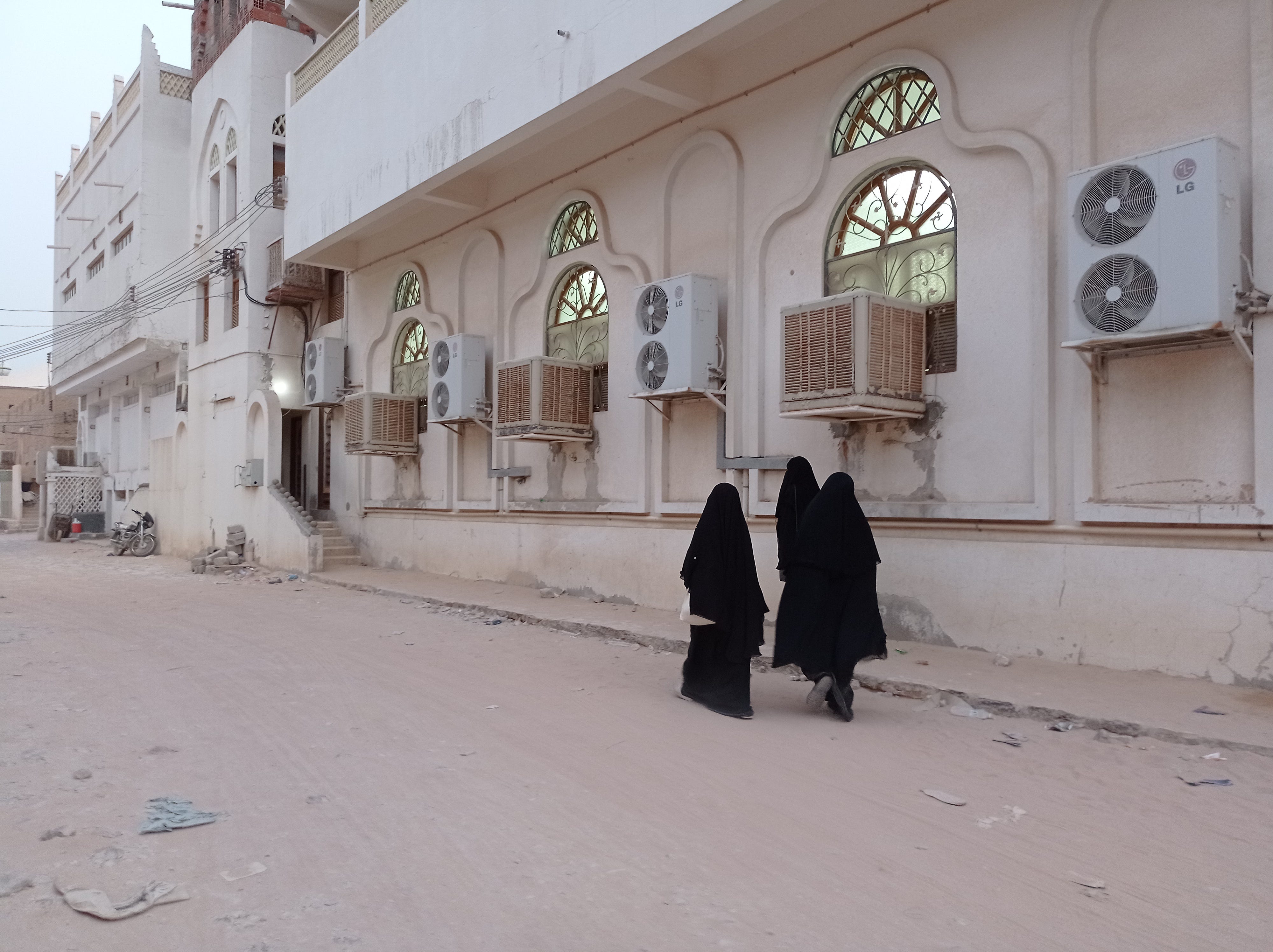
On leaving Seiyun, we drove for 30 minutes before reaching the town of Tarim, Yemen’s spiritual capital - a place of saints regarded by the Sufi community as a lodestar for people who might otherwise have nothing to guide them. Driving through its old neighborhoods, I looked out from the car window at the narrow dusty alleyways separating ancient mud-brick buildings. Motorcycles whizzed past, ridden by men in baggy Yemeni ‘futa’ while women in long dark abayas sat perched on the back, both legs flung over one side. Tarim is said to be home to 365 mosques - enough for a devout Muslim to pray in a different one each day of the year. The ones I glimpsed that first day were simple structures perfectly in-keeping with their surroundings.
Throughout the drive, the two men from the madrassa made us feel safe, shy away their gaze and talked to us just if needed, while making sure to anticipate any needs we might had. The car radio did the talking. It was tuned into the station of Dar al-Mustafa, the twin male institution of Dar Al Zahra, and played a constant stream of the islamic litany will later became the familiar routine of our days in the madrassa. The hypnotic rhythm of the chanting was the ideal soundtrack to the landscape and the fading light. The tone of the voice seem synchronise to the vibrations of the heart. Then, before I knew it, we had arrived.
The Dar al Zahra madrassa is a large white building surrounded by sand and dusty roads outside Tarim’s old city. We pulled up shortly after the Maghrib prayer, greeted by the chatter of kids who appeared near the entrance and showed us inside. Before anything else, I noticed hundreds of shoes at the entrance hall - then came a vibrant explosion of color, voices and laughter. I do not remember much of the evening after that. My American companion and I found ourselves in a room with the woman we would come to know as Ustada Muniba, a very high educated lady in both western academia and Islamic Science. In time, she would turn into a mentor and a true inspiration, teaching us the secrets of humility and leading by example. That night though, I didn’t realise how much she would have meant to me. Instead, I was enchanted by the chorus of drums and nasheeds - Islamic hymns - other students were doing to greet us. Then I was shown to the mattress on the floor that would serve as my bed and I immediately fell asleep.
Dar al Zahra is a madrassa for female students only. Opened in 2001, it was envisioned as a parallel institution to Dar al Mustafa, the higher education institute for men established on nearby grounds in 1994. The madrassa is three stories high, with each floor including a large prayer room, dormitories, library and classrooms. What Yemenis refer to as ‘habibs and ‘ubabas’ - male and female scholars who claim to descend from the Prophet Muhammad - hold regular lectures and meetings for students, but the laughter and drumming that greeted us that first night made it quickly apparent that this would not be a cold, emotionless place. The madrassa serves as a community centre as much as a school. Anyone from the surrounding neighborhoods can visit to attend lectures, or just for the chance to enjoy food and companionship. I was still focused on the formal aspects of study to appreciate what it meant. I had gone there to learn and for the first couple of months that was all I was focused on. My intellect was working, but my heart was still deaf.
The rules for attending Dar Al Zahra were spelled out clearly in the application form I had completed in Kabul months earlier. I knew that access to my cell phone would be allowed only once a week, and even then I would not be allowed to use its camera or connect it to the internet. My access to the web would be limited to one day a month, when I would be allowed a pre-arranged day trip to the home of a local family.
Only the strictness of the dress code surprised me. The shalwar kameez I used to wear in Afghanistan without a second glance from locals was considered too short and revealing even in the privacy of my own dormitory room. Instead, I was required to wear a long, loose-fitting robe. When I slept, I still had to wear a headscarf.
We were encouraged to recognize the all-encompassing nature of Islam and a key part of our learning happened when we were not in the classroom or the prayer room. The teachers wanted us to practice the Sunnah, the Prophet Muhammad’s way of life, in all our behavior. The basics, like eating with our right hands, sitting down while drinking or beginning the morning with a simple meal of dates, were easy. The hard part was internalizing the Prophet’s character traits: cleansing ourselves of selfishness, ostentation and resentment; granting forgiveness deep inside our hearts, always thinking the best of others, talk only if and when is beneficial.
All of us struggled to meet these expectations at various times. We found we were unable to truly forgive personal grievances that had been with us for years. We also argued about everything that ordinary young women anywhere are liable to argue about. There was jealousy, judgement and misunderstanding like in any normal school environment. But every day we were all trying to question ourselves, and behave differently.
Some of the students hung around only with their best friends or tried not to mix with people from different cultural backgrounds. Others tried to befriend the local ‘stars’ - prominent personalities from the families of the habibs, or imams with storied histories in the Hadhramaut. Some of the girls who were the most eager to behave perfectly were the first to fail in giving up resentments and grievance any occurred chance. At times for a convert like me, the hypocrisy was surreal; like an MTV show regulated by Islamic etiquette.
Most days though, I was enchanted by these fellow travellers of a spiritual path, who seemed genuinely focused on trying to make the world a better place by make themselves better people. We all had flaws, but we recognized that fact and knew that deep down we were there to heal ourselves. And that became our indissoluble bond.
Almost all of the girls I met, and those who later became my close friends, proudly wore the niqab in their home countries. Many of them had never shown their faces, or even spoken to, men outside their own families as adults. It is surprising how quickly even such extreme behavior can come to feel normal. I have always considered myself a socially progressive and politically radical woman, but I began to find the seclusion and segregation strangely comforting - liberating, even.
The men in the madrassa became like Oompa Loompas to me, busy working in the background, fixing problems and organizing things, without ever interacting with us. The few lessons we had with male teachers were conducted with them talking to us from a separate room via a microphone. We wrote our questions on a piece of paper that we passed through a crack under the door. It was a women-only world and after a while that felt natural.
Life in the madrassa was shaped around the five compulsory prayers of the day and this routine left us with little time to do anything but study and worship. After a while, there was a certain hypnotic, meditative, quality to it all. We woke around 3.30am and headed to the Musalla, the prayer room, located a few steps from the dormitories, near the entrance to the building. We stayed there reciting liturgies, until Fajr, the first formal prayer of the day. Then we would try to memorize passages from the Qur’an and catch up on homework, before taking breakfast and beginning our actual classes.
When school was over for the morning, we had time to hang out with friends or go shopping in the tiny supermarket and bookstore within the school. Then it was time for lunch, which usually consisted of rice with chicken or fish. In the afternoons, the majority of us indulged in a siesta, known as alqaylula in Arabic and considered in keeping with the Sunnah. We were usually woken by the call to the asr prayer, after which we would again study. Then, between the maghrib and isha prayers in the evening, we recited verses from the Qur’an or chanted Hadhramaut poetry. After dinner, it was again time to study before all the lights were switched off at 10.30pm and we went to sleep.
This kind of timetable may sound draconian, but it didn’t feel that way. The teachers were very flexible with me, perhaps because I was older than most of the students and had a relatively limited Islamic background. For the first couple of months, I was allowed to study only what I found easy. I struggled to memorize the Qur’an and didn’t place much importance in the madrassa’s routine. My main concerns were prosaic: I wanted to get the muscles of my tongue and glottis used to the textures of Arabic speech, with its words that roll from the top of the mouth, and I tirelessly repeated the sounds of letters I found difficult to pronounce.
At the same time, I devoured almost every English-language book on Sufism that I could find in the library and studied extra books on Arabic grammar that I had brought with me from Italy. When I felt bored or alone, I reminded myself that I had taken this sabbatical from work and life to study the intricacies of Arabic and Islam. I was here to learn, and to learn fast; everything else seemed ornamental, a cornice unworthy of much attention. But I could not have been more wrong. I had become too accustomed to secular education, with its emphasis on critical thinking. I needed to trust the different processes and teaching methods of the madrassa, where memorization was the key to unlocking the truth.
Dar al Zahra is organized to teach its students a new approach to life, one that finds meaning not in the pursuit of wealth or pleasure, but in the pursuit of knowledge that is both intellectualized and practiced. The staff do not dictate how this should be done; even within the confines of its walls, and the regimentation of its routines, a freedom of sorts is encouraged. Our dorm rooms were routinely locked during school hours, or when we were meant to be reciting liturgies, but it was not uncommon to find girls lying in the corridors, trying to steal an extra hour’s sleep or chatting with friends like teenagers in the bathroom of a high school.
The senior teachers knew this was going on, but they never reproached us. Dar al Zahra was not the Islamic equivalent of an austere monastery, nor was it the kind of madrassa so often featured in Western media accounts of Islamic schools, with corporal punishment imposed on misbehaving or under-performing students. Instead, it felt more like the cramped, street-level bassi houses of Naples, which are vibrant and full of life.
While the world was struggling with COVID, we were happily self-contained in a natural social bubble. I ate rice from the same plate as ten other students. If there was any food left, we all took it back to our rooms and shared it there. Just moving around the building was a communal activity. We talked with each other while queuing to wash or use the toilet, and gossiped about our lectures. If we wanted isolation and solitude, we had to go actively looking for it, often in the Musalla or in a remote corner of the building.
At times I felt a tiredness deep in my bones, but that wasn’t because of the studying, it was because of the desert wind that kept me awake at night, sweeping down from the chain of mountains that guarded the horizon. Some of the students grew so tired they spent whole days in the medical room just trying to catch up on sleep. In the end, I found that the only way to cope was to synchronize my mind and body to Dar al Zahra’s schedule, rather than try to fight it. When I did this, I felt synchronised with the whole world rather than isolated from it.
I realized how different life in the madrassa might be from the rest of Yemen during a rare trip outside, to Daw’an, a historic town in the middle of the desert, surrounded by palm trees. I was travelIng with a couple of students, and one of the ubaba that used to teach us evening lectures. The first time I had met her she was in the Musalla, praying behind me. I made some mistakes and she kindly corrected my movements once I had finished.
As soon as we arrived in Da’wan to visit the grave of a local saint, some kids showed up and passed on an invitation to lunch from a well-known family. We were all fully covered in our abayas and niqabs, yet somehow word of the ubaba’s arrival had already spread through town. The women of the family welcomed us with food and chanted prayers. Although my Arabic is still only basic, I could tell the respect they had for the ubaba. All the women we met that day were dressed fashionably, but my friends from the madrassa refused to remove their abayas despite the unbearable heat.
As the conversation flowed, I understood that a lot of young people in Da’wan looked to Saudi Arabia as place of excitement and modernity, with social and economic opportunities that Yemen lacked. It reminded me of the way young women in the West regard London or New York. They spent time chewing Qat, frustrated by the lack of jobs locally, and had little interest in tradition or the grave of the saint we had come to visit. “Please, take my son to study with you back in Tarim,” one of the women said to the Ubaba.
The veneration of shrines that is so common among the Hadhramaut’s Sufi community has often caused tension with local Wahhabis. But the real source of the discontent seemed to be a realization among many people that modernization has consistently failed them. Hadhramaut’s history is defined by a long series of wars between tribesmen of various clans and the lack of a strong central government has tended to result in arbitrary authority and economic insecurity. Locals who aren’t in Tarim often travel overseas in search of better lives, while the land they leave behind remains isolated and forgotten. Even when Hadhramaut was part of a British protectorate in the nineteenth and twentieth centuries, it lay on the desolate fringes of the empire.
For local people then, Tarim stands as a symbol of pride and righteousness - separate from this surrounding despair. The lessons taught at the madrassa are seen as not only being tools for dawah - the spread of the Islamic faith - but as a route to a type of economic progress that is in keeping with the best of Yemeni culture and history. Tarimis often tell the story of Al Faqih Muqaddamm, the sufi scholar of the eleventh and twelfth century founder of the Ba’Alawiyya tariqa we followed.
At a time of political instability and local power struggles between tribes, Muqaddam chose not to fight but to break his sword. “The only sword I will use is the sword of knowledge,” he is said to have proclaimed. Since then, the people of Tarim have revered knowledge and abhorred violence. When I was at the madrassa, it was considered disrespectful not only to leave books on the floor but also pens. We were told that pens should be placed on tables or, since we always sat on the floor anyway, cradled respectfully in our crossed legs.
This reverence for learning has probably helped protect Hadhramaut from the turmoil around it. From the late 1960s to 1990, South Yemen was a communist one-party state, leading to the persecution of religious scholars. But the people of Hadhramaut clung to their faith and their history. Even today, the valley is regarded as a sanctuary for visitors of all kinds, including criminals on the run and people seeking respite from the on-going war. Around 13 million Yemenis are at risk of starvation because of the conflict. Some of the Yemeni girls studying at the madrassa could not return home to their families during holidays due to insecurity on the roads. Others who came from cities like Marib, where battles were ongoing, left without knowing if they would be able to return to pursue their studies. In Sayun, I was struck by the number of drivers desperately queuing for petrol in the cars - a staggering sight in a country with ample oil reserves.
Tarim, however, was the first place I had been to in all my traveling through the Muslim world where the wealth of the west had no discernible influence on the perceived social value of an individual. In Dar al Zahra, I met students from the US who were looking forward to getting good dental care in Yemen, which they could never afford in America’s private health system. Some families had left their homes in Europe and settled in the madrassa because it was cheap to live there. The very basic narratives about life and well-being that we in the west are taught to believe from childhood were overturned or, in my case, revealed. The rush towards a uniform kind of progress, in which knowledge is commodified and the individual is prized over the collective, has led us to forget that their are many ways to have a fulfilling existence, not just the one we are sold.
Leaving Dar Al Zahra was not easy for me. The hugs, love, and tears while I was about to leaving the door still hunt me. As per tradition, I shout: “ La ilaha illallah– there is not God but Allah” three times before leaving, while the girls replied in chore each time: “Muhammadur Rasulullah –Mohamed is the Messeenger of Allah. The power of what I experienced lies in that moment, and those words so meaningful for every Muslim.
Ultimately, I knew that Dar al Zahra was an idea as much as a physical location, a way for me to live that I could carry into the future. Back in home in Italy I struggled to navigate between the thousands of choices I am expected to make each day on things as trivial as what to wear or what to eat. And at times, I still do.
It feels harder to have a fulfilling life here when I am constantly hit with images and narratives that seem impossible to avoid. I know these narratives clash with my direct experience of the world, with the hard-earned knowledge I have acquired, but I worry that they still affect my understanding of who I am and what the future holds for us all.
When I was at the madrassa and told that a watch was one of only five possessions I needed, I did not immediately grasp the full significance of the advice. But as I stayed there it began to dawn on me: time was elastic and the opportunities it provided infinite. Here it vanishes without me even realizing it, choking me. I catch my breath again with the calls I make on Thursday to some of the girls back at Dar al Zahra. Their life reminds me that self-discipline is capable of heal the soul, and bringing freedom. “The world is in crisis because of a lack of role models.” a sheikh once told me. It was among the students and teachers of a madrassa in Yemen that I found mine.
Mashallah. I have not been in Tarim for almost 10 years, but your recount took me back like I was there yesterday. May our hearts always be attached to tarim and Ahl Tarim.
ماشاء الله تبارك الله
Ya Haidarah, please keep us in your prayer please..
Lot of ♡
Your ustadha♡